For Brokers
Estimate your max LTV in seconds
Pick the town, product, credit score, and how close the property is — we'll show the maximum loan-to-value we can consider. No sign-up, no obligation.
Castlegar
Lending guidelines for Castlegar, British Columbia
Last reviewed by Bridgefort Capital on
Show on MapLending Snapshot
Castlegar is a steady, single-family-dominated regional hub in the Kootenays, popular with retirees and downsizers. We’re lending up to 65.0% LTV here. It’s a reliable lifestyle market, but the 10.8% unemployment rate and resource-dependent roots mean we keep our underwriting practical and realistic.
Underwriting Castlegar: A Blue-Collar Anchor in the West Kootenay
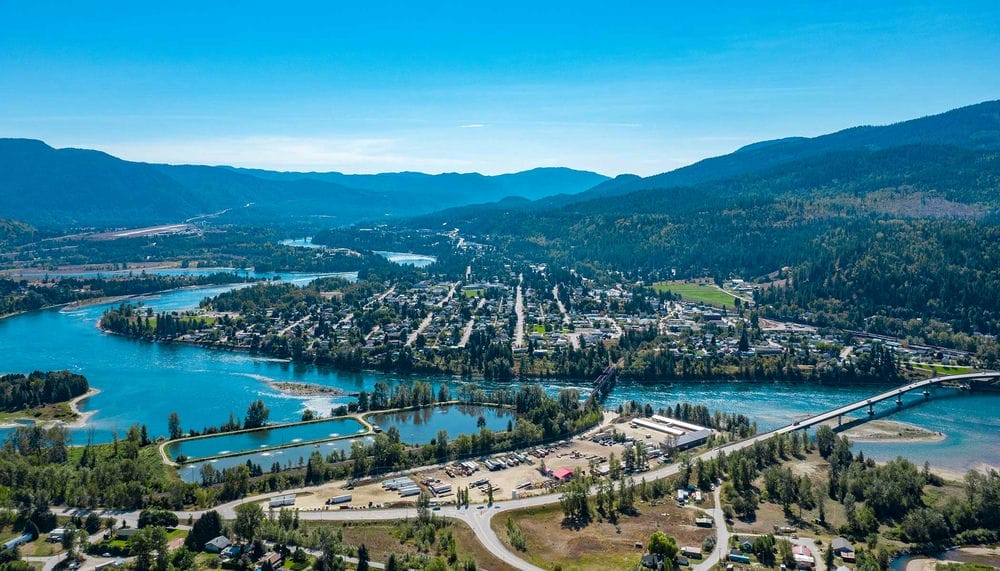
Castlegar sits right at the confluence of the Columbia and Kootenay rivers, acting as the blue-collar engine of the West Kootenay region. While Nelson gets the press for its lifestyle and arts scene, Castlegar is where the real work gets done. It sits at the junction of Highway 3 and 3A, making it the primary hub for transportation, heavy industry, and regional services. For mortgage brokers placing deals in the BC Interior, this is a remarkably stable, self-contained market. We like lending here because the economic foundation is predictable.
The local economy does not care about the ups and downs of seasonal tourism. It relies on industrial roots, anchored by forestry and the Mercer Celgar pulp mill. Beyond heavy industry, there is a steady flow of public-sector funding from the main campus of Selkirk College, alongside consistent employment in regional healthcare and retail. Even the West Kootenay Regional Airport, despite its local reputation for winter weather cancellations, keeps logistics and business travel moving. Most residents work in manufacturing, healthcare, or retail. These are primary homeowners paying mortgages with stable, local paycheques, not speculators relying on short-term rentals.
From an underwriting perspective, geography protects Castlegar from housing bubbles. Squeezed between steep valley walls and two major rivers, the city cannot easily sprawl. This physical constraint keeps housing supply tight. Over two-thirds of the local housing stock consists of single-detached homes, many of them modest, mid-century builds. Because developers cannot easily clear new land outward, the market has shifted toward infill projects and carriage houses. This limited inventory, paired with prices that remain highly affordable compared to nearby resort towns like Rossland, keeps demand incredibly consistent. People move here for the short commutes—typically under twenty minutes—and practical living.
When we price risk at Bridgefort Capital, we focus heavily on how a property holds its value when the broader economy softens. Castlegar is a primary-residence market, not a playground for recreational buyers, so demand does not vanish during a downturn. If a single-family home is priced right, it will sell because local families need roofs over their heads. That basic utility is why our maximum LTV for Castlegar is 65%.
We position ourselves right between the conservative guidelines of local credit unions and the high costs of big-city private lenders. We understand how to navigate files that do not fit the standard A-lender box. Maybe you have a mill worker needing a second mortgage to clean up credit, a self-employed contractor with undocumented income, or a senior transitioning between properties who needs bridge financing. If there is clear equity and a logical exit strategy, we will find a way to write the business.
the Nearest Costco
Nearest Hospital
Frequently Asked Questions
Our max LTV is capped at 65.0% for standard residential properties. This limit respects the strong local lifestyle demand while factoring in the area's 10.8% unemployment rate and economic reliance on the resource sector.
While healthcare and retail lead employment, the town still has deep mill-town roots and a 10.8% unemployment rate. Deals go through smoothly when borrowers have stable, proven incomes that aren't overly vulnerable to resource sector downturns.
Bringing us speculative condo projects or highly volatile vacation rentals will sink a deal fast. We are looking for straightforward, primary-residence single-detached homes, which make up nearly 68% of the local housing stock.
Our Mortgage Products Available in Castlegar
| Mortgage Product Name | Max LTV | Key Notes for Castlegar |
|---|---|---|
| Credit Repair and Debt Consolidation | 65.0% | Standard product terms |
| Variable Income | 65.0% | Standard product terms |
| Bare Land and Unique Properties | 65.0% | Standard product terms |
| Bridge Financing | 65.0% | Standard product terms |
| Equity Lending / Refinance | 65.0% | Standard product terms |
| Purchases | 65.0% | Standard product terms |
Detailed Mortgage Product Information
Credit Repair and Debt Consolidation
Maximum Loan-to-Value (LTV) for Credit Repair and Debt Consolidation in Castlegar:
65.0 %
“Their credit report reads like a horror novel, but the house was just renovated and is worth a lot…”
Here’s what happens when life takes a wrong turn. A bad business venture. Workplace Injury. That divorce that dragged on for two years. Suddenly your credit score looks like a batting average and the banks won’t even return your calls.
But here’s the thing – none of that changes what your ho...
Variable Income
Maximum Loan-to-Value (LTV) for Variable Income in Castlegar:
65.0 %
“Their income is all over the map, but there’s definitely income…”
Here’s a funny thing about lending based on Line 15000 of your Notice of Assessment: It’s a neat little box to underwrite against. Works great if you’re a salaried employee. Not so great if you’re running a fishing charter in Campbell River where thres fishing season, and the rest of the year.
We get it. Income isn’t always ti...
Bare Land and Unique Properties
Maximum Loan-to-Value (LTV) for Bare Land and Unique Properties in Castlegar:
65.0 %
“The appraisal came back as ‘property type: other’…”
Here’s a truth about real estate that nobody wants to admit: not everything fits in a box. Banks have boxes. Nice, tidy boxes labeled “single family home” and “condo” and “townhouse.” Their computer systems literally don’t have a dropdown menu option for “converted church with commercial kitchen” or “geodesic dome on 40 acres.”
We’ve funded...
Bridge Financing
Maximum Loan-to-Value (LTV) for Bridge Financing in Castlegar:
65.0 %
“Subjects came off their current home last week but their new place closes Friday…”
Here’s a funny thing about bridge financing: everyone thinks it’s complicated. It’s not. Someone needs to close on their new house before their old house sells. Or their sale fell through after they removed subjects on their dream home. Or they found the perfect downsizer condo but haven’t listed the family hom...
Equity Lending / Refinance
Maximum Loan-to-Value (LTV) for Equity Lending / Refinance in Castlegar:
65.0 %
“They have tons of equity but don’t qualify under B20…”
Here’s the thing about equity lending: it exists because banks literally can’t do it. B20 guidelines require income verification. Full stop. No wiggle room. No common sense exceptions.
We’re provincially regulated. The funds we lend on come from individual investors, not the Bank of Canada. So when your client has 50% equity but their in...
Purchases
Maximum Loan-to-Value (LTV) for Purchases in Castlegar:
65.0 %
Moving is supposed to be exciting. New town, new job, new chapter. So why do banks act like you’re asking for their firstborn when you need a mortgage?
“You haven’t been at your new job for thre months”
“Your self-employment income doesn’t count in a new market.”
“We need to see established a year if you are part time contract - even if you’re working 40 hours under your new role”
Meanwhile...