For Brokers
Estimate your max LTV in seconds
Pick the town, product, credit score, and how close the property is — we'll show the maximum loan-to-value we can consider. No sign-up, no obligation.
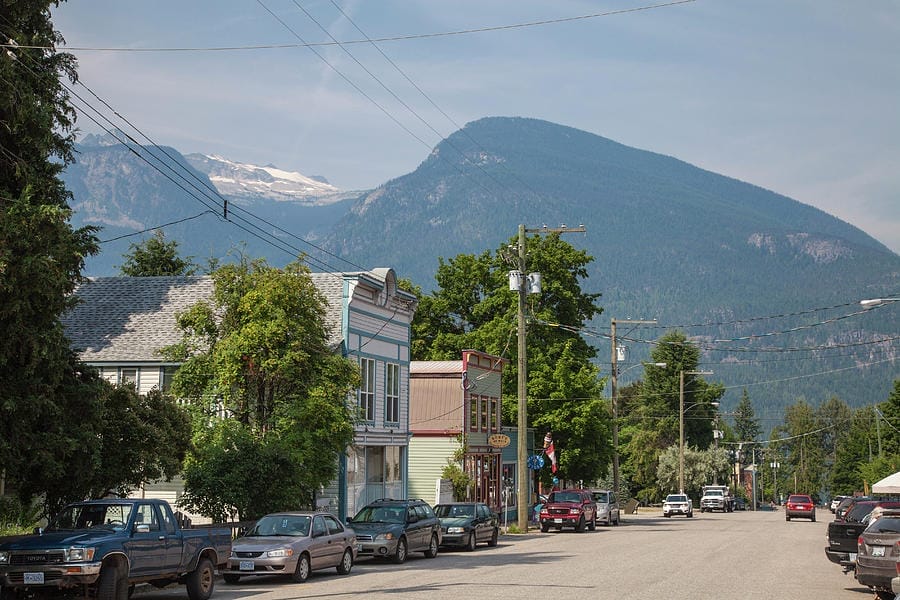
New Denver
Lending guidelines for New Denver, British Columbia
Last reviewed by Bridgefort Capital on
Show on MapLending Snapshot
New Denver is a tiny, quiet retirement community where we cap our LTV at a strict 55.0%. The local economy is small and fragile with high unemployment, meaning foreclosures here face a very niche buyer pool. We're a fit here, but only for well-capitalized buyers and retirees with plenty of equity.
Lending in New Denver: Underwriting the Slocan Valley
New Denver sits on the east shore of Slocan Lake, right under the Valhalla mountains. With a population of just 487 people, it is exactly the type of small Kootenay market where traditional big banks refuse to tread. At Bridgefort Capital, we have always been the MIC for towns without stoplights, and New Denver fits that description perfectly. It is a quiet, historic village with a slow pace, a rich silver mining heritage, and a deep history as a WWII Japanese Canadian internment site. This is not a bustling, high-volume resort market like Nelson or Revelstoke.
If you are bringing us a deal in this pocket of the West Kootenays, you have to understand the local demographics first. The median age here is 62, and 45% of the population is over the age of 65. People do not move to New Denver to climb the corporate ladder. They move here to retire, hike the Galena Trail, or run small, lifestyle-driven businesses. The local economy relies on summer tourism, retail trade, construction, and a handful of professional services. Over 68% of the working population commutes less than 15 minutes, reflecting a highly localized, self-contained work force. Because of this limited economic engine and the lack of major industrial employers, we rate the local economy at a 4 out of 10. However, the community desirability is an 8 out of 10. The people who live here are fiercely committed to the Slocan lifestyle, keeping demand for the limited housing stock surprisingly stable.
The real estate market here is tiny. There are only about 304 private dwellings in the entire municipality, and 84% of them are single-detached houses. Many of these are early 1900s heritage homes, mixed with mid-century builds and a few newer custom properties. Because the village is geographically constrained by Slocan Lake on one side and steep mountain terrain on the other, you are not going to see sudden inventory spikes or new subdivisions. This physical boundary keeps prices stable, but it also means transaction volume is exceptionally low. Comparable sales can be tough to find, and properties can sit on the market for months.
As a private equity lender funded by friends and family, our primary concern is capital preservation and exit liquidity. If we have to foreclose on a property in a town of under 500 people that is a two-hour drive from the airport in Castlegar, we have to plan for a prolonged carrying period. Because of this limited liquidity, our maximum LTV for New Denver is capped at 55.0%.
Traditional lenders and local credit unions often draw a hard line at remote postal codes or reject borrowers with unconventional, seasonal, or retired income streams. We look at the bigger picture. If your client needs a clean bridge loan to purchase a lakeside retirement home before their principal residence in the Lower Mainland or the Okanagan sells, we can make that work. We also look at equity take-outs on Main Street properties for debt consolidation or renovations. If the real estate asset is solid and there is a realistic exit strategy, we want to look at the file. We know the Slocan Valley, and we are ready to fund deals in New Denver.
the Nearest Tim Hortons
the Nearest Costco
Nearest Hospital
Frequently Asked Questions
Our max LTV is a hard 55.0% to offset the risks of a tiny, stagnant market. If we ever have to foreclose, the buyer pool is highly niche and properties take a long time to sell.
With a median household income of $46,400 and high unemployment, we don't rely on local wages. We focus on equity-rich borrowers, like retirees downsizing or locals consolidating debt.
Any request for a high-ratio mortgage or a buyer without a massive equity cushion is an immediate deal-breaker. Our 55.0% LTV limit is a firm ceiling with zero exceptions.
Our Mortgage Products Available in New Denver
| Mortgage Product Name | Max LTV | Key Notes for New Denver |
|---|---|---|
| Credit Repair and Debt Consolidation | 55.0% | Standard product terms |
| Variable Income | 55.0% | Standard product terms |
| Bare Land and Unique Properties | 55.0% | Standard product terms |
| Bridge Financing | 55.0% | Standard product terms |
| Equity Lending / Refinance | 55.0% | Standard product terms |
| Purchases | 55.0% | Standard product terms |
Detailed Mortgage Product Information
Credit Repair and Debt Consolidation
Maximum Loan-to-Value (LTV) for Credit Repair and Debt Consolidation in New Denver:
55.0 %
“Their credit report reads like a horror novel, but the house was just renovated and is worth a lot…”
Here’s what happens when life takes a wrong turn. A bad business venture. Workplace Injury. That divorce that dragged on for two years. Suddenly your credit score looks like a batting average and the banks won’t even return your calls.
But here’s the thing – none of that changes what your ho...
Variable Income
Maximum Loan-to-Value (LTV) for Variable Income in New Denver:
55.0 %
“Their income is all over the map, but there’s definitely income…”
Here’s a funny thing about lending based on Line 15000 of your Notice of Assessment: It’s a neat little box to underwrite against. Works great if you’re a salaried employee. Not so great if you’re running a fishing charter in Campbell River where thres fishing season, and the rest of the year.
We get it. Income isn’t always ti...
Bare Land and Unique Properties
Maximum Loan-to-Value (LTV) for Bare Land and Unique Properties in New Denver:
55.0 %
“The appraisal came back as ‘property type: other’…”
Here’s a truth about real estate that nobody wants to admit: not everything fits in a box. Banks have boxes. Nice, tidy boxes labeled “single family home” and “condo” and “townhouse.” Their computer systems literally don’t have a dropdown menu option for “converted church with commercial kitchen” or “geodesic dome on 40 acres.”
We’ve funded...
Bridge Financing
Maximum Loan-to-Value (LTV) for Bridge Financing in New Denver:
55.0 %
“Subjects came off their current home last week but their new place closes Friday…”
Here’s a funny thing about bridge financing: everyone thinks it’s complicated. It’s not. Someone needs to close on their new house before their old house sells. Or their sale fell through after they removed subjects on their dream home. Or they found the perfect downsizer condo but haven’t listed the family hom...
Equity Lending / Refinance
Maximum Loan-to-Value (LTV) for Equity Lending / Refinance in New Denver:
55.0 %
“They have tons of equity but don’t qualify under B20…”
Here’s the thing about equity lending: it exists because banks literally can’t do it. B20 guidelines require income verification. Full stop. No wiggle room. No common sense exceptions.
We’re provincially regulated. The funds we lend on come from individual investors, not the Bank of Canada. So when your client has 50% equity but their in...
Purchases
Maximum Loan-to-Value (LTV) for Purchases in New Denver:
55.0 %
Moving is supposed to be exciting. New town, new job, new chapter. So why do banks act like you’re asking for their firstborn when you need a mortgage?
“You haven’t been at your new job for thre months”
“Your self-employment income doesn’t count in a new market.”
“We need to see established a year if you are part time contract - even if you’re working 40 hours under your new role”
Meanwhile...