For Brokers
Estimate your max LTV in seconds
Pick the town, product, credit score, and how close the property is — we'll show the maximum loan-to-value we can consider. No sign-up, no obligation.
Princeton
Lending guidelines for Princeton, British Columbia
Last reviewed by Bridgefort Capital on
Show on MapLending Snapshot
Princeton is a small, blue-collar resource town where we cap our LTV at 50%. The local economy relies heavily on mining, making it highly vulnerable to commodity crashes and low real estate liquidity. If a deal goes sideways, it can take up to eight months to sell, so we have to play it safe here.
Princeton and the Similkameen
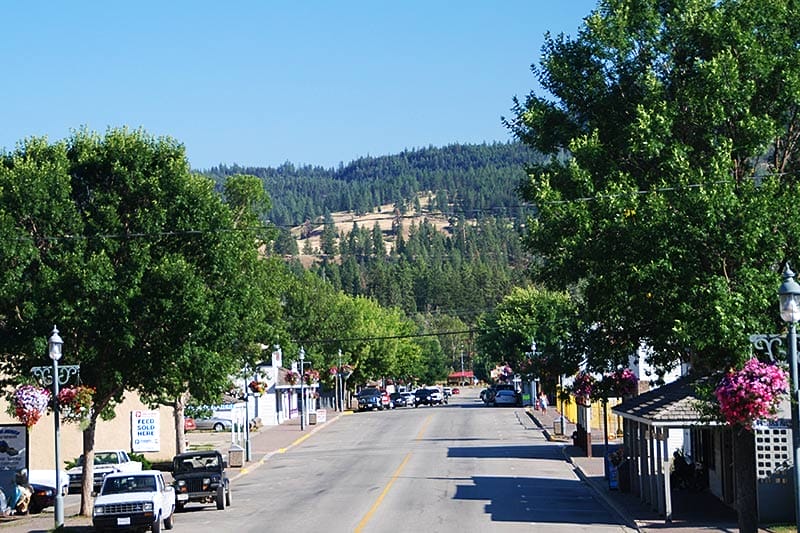
Princeton sits at the junction of the Tulameen and Similkameen rivers, right where Highway 3 meets Highway 5A. This location serves as the southern gateway to the British Columbia Interior. With a population of 2,894, representing a modest 2.3% growth since 2016, it remains a quiet, resource-driven community. The population density is low at 48.8 people per square kilometer across a land area of 59.28 square kilometers. The median age here is 52 years, reflecting a demographic split where seniors aged 65 and older make up 29% of the population, while the working-age demographic of 15 to 64 accounts for 58%. It is an area that appeals to retirees, resource sector workers, and individuals seeking a more affordable, dry-climate alternative to the Okanagan or the Lower Mainland.
Economic Drivers and Income Profile
When underwriting files in Princeton, the employment mix is highly concentrated in primary industries. Mining, quarrying, and oil and gas extraction make up the largest segment of the local workforce at 19.6%, followed by manufacturing at 15.1%. Retail trade and health care also support the local economy, accounting for 12.5% and 12.1% of employment respectively. The local unemployment rate sits at 11.0%, with an employment rate of 47.5%. This is not a commuter suburb; the average commute time is 18.0 minutes, and 56.1% of working residents commute under 15 minutes, highlighting a highly localized labor market. Education levels reflect this industrial base: while 50.0% of the population holds some form of post-secondary credential, only 14.2% have obtained a bachelor’s degree or higher.
Real Estate Landscape and Liquidity
The housing stock in Princeton presents specific collateral considerations. Single-detached homes make up 66.2% of the market. Crucially, movable dwellings, such as mobile and manufactured homes, account for a significant 16.0% of the housing inventory. Apartments in buildings with fewer than five storeys make up 8.4%, while row houses and duplexes represent minor fractions. For residential mortgages, the high proportion of movable dwellings requires careful property assessment, as these assets depreciate differently and face narrower secondary market demand. Most files we review in this region involve equity take-outs, debt consolidation, or bridge financing for local homeowners rather than high-leverage purchases.
Underwriting Parameters and LTV Limits
Lending in smaller, resource-dependent markets requires a conservative approach to capital preservation. In the event of a market downturn or a mill closure, property liquidity drops rapidly. Extended marketing times during a foreclosure eat into equity through accumulated interest and legal costs. To mitigate these geographical risks, our maximum loan-to-value ratio for Princeton is capped at 50.0%. We look for clean, well-maintained properties with clear valuations and realistic exit strategies. Brokers presenting deals in this market should focus on establishing clear property condition reports and realistic valuation comparables to ensure alignment with our conservative lending threshold.
the Nearest Tim Hortons
the Nearest Costco
Frequently Asked Questions
Our maximum LTV is 50% because the local real estate market is highly illiquid. If a mortgage goes into default, it takes six to eight months to sell a property here, and we have to factor in a 10% to 15% price discount just to get it sold.
With an 11% unemployment rate and nearly 20% of jobs tied directly to mining, the economy lacks diversification. We need to see strong, stable borrower income that can withstand commodity downturns and single-employer disruptions.
Movable dwellings or highly quirky properties are an automatic no-go, as they are incredibly tough to resell. To get a deal done, we need a standard, single-detached home that appeals to the broader local market.
Our Mortgage Products Available in Princeton
| Mortgage Product Name | Max LTV | Key Notes for Princeton |
|---|---|---|
| Credit Repair and Debt Consolidation | 50.0% | Standard product terms |
| Variable Income | 50.0% | Standard product terms |
| Bare Land and Unique Properties | 50.0% | Standard product terms |
| Bridge Financing | 50.0% | Standard product terms |
| Equity Lending / Refinance | 50.0% | Standard product terms |
| Purchases | 50.0% | Standard product terms |
Detailed Mortgage Product Information
Credit Repair and Debt Consolidation
Maximum Loan-to-Value (LTV) for Credit Repair and Debt Consolidation in Princeton:
50.0 %
“Their credit report reads like a horror novel, but the house was just renovated and is worth a lot…”
Here’s what happens when life takes a wrong turn. A bad business venture. Workplace Injury. That divorce that dragged on for two years. Suddenly your credit score looks like a batting average and the banks won’t even return your calls.
But here’s the thing – none of that changes what your ho...
Variable Income
Maximum Loan-to-Value (LTV) for Variable Income in Princeton:
50.0 %
“Their income is all over the map, but there’s definitely income…”
Here’s a funny thing about lending based on Line 15000 of your Notice of Assessment: It’s a neat little box to underwrite against. Works great if you’re a salaried employee. Not so great if you’re running a fishing charter in Campbell River where thres fishing season, and the rest of the year.
We get it. Income isn’t always ti...
Bare Land and Unique Properties
Maximum Loan-to-Value (LTV) for Bare Land and Unique Properties in Princeton:
50.0 %
“The appraisal came back as ‘property type: other’…”
Here’s a truth about real estate that nobody wants to admit: not everything fits in a box. Banks have boxes. Nice, tidy boxes labeled “single family home” and “condo” and “townhouse.” Their computer systems literally don’t have a dropdown menu option for “converted church with commercial kitchen” or “geodesic dome on 40 acres.”
We’ve funded...
Bridge Financing
Maximum Loan-to-Value (LTV) for Bridge Financing in Princeton:
50.0 %
“Subjects came off their current home last week but their new place closes Friday…”
Here’s a funny thing about bridge financing: everyone thinks it’s complicated. It’s not. Someone needs to close on their new house before their old house sells. Or their sale fell through after they removed subjects on their dream home. Or they found the perfect downsizer condo but haven’t listed the family hom...
Equity Lending / Refinance
Maximum Loan-to-Value (LTV) for Equity Lending / Refinance in Princeton:
50.0 %
“They have tons of equity but don’t qualify under B20…”
Here’s the thing about equity lending: it exists because banks literally can’t do it. B20 guidelines require income verification. Full stop. No wiggle room. No common sense exceptions.
We’re provincially regulated. The funds we lend on come from individual investors, not the Bank of Canada. So when your client has 50% equity but their in...
Purchases
Maximum Loan-to-Value (LTV) for Purchases in Princeton:
50.0 %
Moving is supposed to be exciting. New town, new job, new chapter. So why do banks act like you’re asking for their firstborn when you need a mortgage?
“You haven’t been at your new job for thre months”
“Your self-employment income doesn’t count in a new market.”
“We need to see established a year if you are part time contract - even if you’re working 40 hours under your new role”
Meanwhile...