For Brokers
Estimate your max LTV in seconds
Pick the town, product, credit score, and how close the property is — we'll show the maximum loan-to-value we can consider. No sign-up, no obligation.
Tahsis
Lending guidelines for Tahsis, British Columbia
Last reviewed by Bridgefort Capital on
Show on MapLending Snapshot
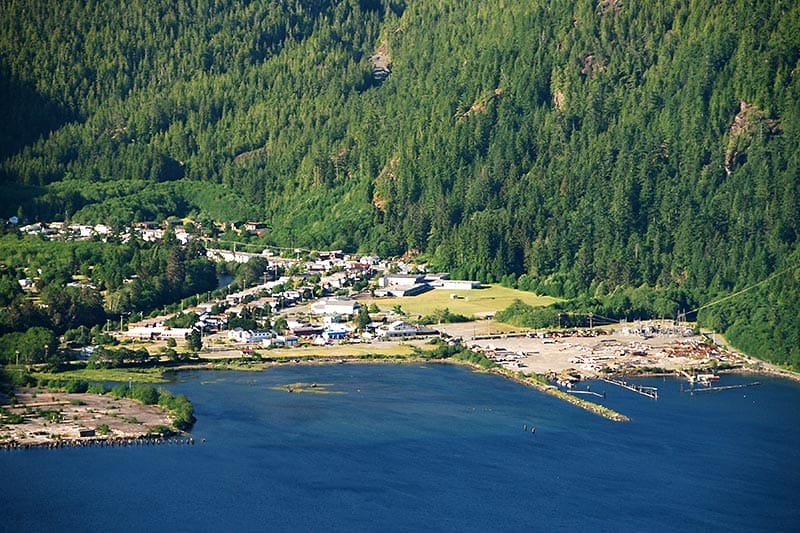
Tahsis is a remote, end-of-the-road lifestyle destination with a tiny population of under 400. Because the local economy is fragile and highly illiquid, we cap our lending at a conservative 45.0% LTV. This market is strictly for well-capitalized lifestyle buyers or retirees, not speculative investors.
Lending at the End of the Road in Nootka Sound
When we say we lend in towns without stoplights, Tahsis is exactly the place we mean. It sits at the deep end of a long fjord on the rugged west coast of Vancouver Island. Getting there requires driving 60 kilometers down an active gravel logging road past Gold River. For the 393 people who live here year-round, that isolation is the draw. For us, it is the primary factor we look at when underwriting.
Tahsis is a classic coastal boom-and-bust town. Built around a massive sawmill in the 1940s, it did not even get road access to the rest of the island until 1972. In its logging prime, thousands of people lived here. Since the last mill closed in 2001, the population has shrunk to a fraction of its former peak. Today, it is mostly a quiet haven for retirees, people looking to live off-grid, and summer sport fishermen.
Local Economy and Real Estate Realities
The local numbers explain the market dynamic. The median age is 58, and nearly a third of the population is over 65. The official unemployment rate sits at 35.7%, which reflects a highly seasonal, tourism-dependent economy. Outside of summer fishing, boating, and eco-tourism, year-round employment is scarce. Most stable year-round jobs are in public administration, which accounts for over 22% of local employment, or basic infrastructure maintenance.
For buyers, the main appeal is price. Tahsis offers some of the cheapest housing in British Columbia. Single-detached homes make up 67.4% of the properties here, and they sell for a tiny fraction of what you would pay elsewhere on Vancouver Island. That low entry point attracts retirees on fixed pensions, remote workers looking to escape city prices, and people wanting a cheap summer basecamp.
Underwriting in an Isolated Market
Low prices are fine for buyers, but as a lender, we have to think about liquidity. The real estate market in Tahsis is exceptionally quiet. Sales are rare, and listings can sit on the market for months, especially during the wet winter season. If a borrower defaults and we have to step in, we face the reality of trying to sell a property in an isolated coastal village in the middle of January. There are also physical risks: the town sits on a river floodplain, and that single access road can wash out during major winter storms.
Because we lend capital from friends and family, protecting that principal is our priority. We will look at deals in Tahsis, but we use conservative limits to offset the long timelines of a potential foreclosure. Because of the tiny buyer pool and the geographic isolation, our maximum loan-to-value for properties in Tahsis is 45.0%.
If you have a client buying a retirement spot or a fishing cabin who has the equity to make a conservative deal work, send us the file. Just keep in mind that our terms will always reflect the practical realities of lending at the literal end of the road.
the Nearest Tim Hortons
the Nearest Costco
Nearest Hospital
Frequently Asked Questions
With under 400 residents, this is an incredibly illiquid market where foreclosures can take a long time to sell. The 45.0% LTV limit keeps us safe from high carrying costs if we ever have to step in and sell the property.
The local economy is very weak, featuring a 35.7% unemployment rate and a low $42,000 median household income. To get a deal done, your clients must be financially self-sufficient—think retirees or buyers with outside income, not people relying on local jobs.
Any deal looking for high leverage or pitched as a speculative investment flip will get rejected immediately. If your borrower doesn't have a huge down payment and a solid, long-term commitment to the area, it's a non-starter.
Our Mortgage Products Available in Tahsis
| Mortgage Product Name | Max LTV | Key Notes for Tahsis |
|---|---|---|
| Bridge Financing | 45.0% | Standard product terms |
| Equity Lending / Refinance | 45.0% | Standard product terms |
| Purchases | 45.0% | Standard product terms |
Detailed Mortgage Product Information
Bridge Financing
Maximum Loan-to-Value (LTV) for Bridge Financing in Tahsis:
45.0 %
“Subjects came off their current home last week but their new place closes Friday…”
Here’s a funny thing about bridge financing: everyone thinks it’s complicated. It’s not. Someone needs to close on their new house before their old house sells. Or their sale fell through after they removed subjects on their dream home. Or they found the perfect downsizer condo but haven’t listed the family hom...
Equity Lending / Refinance
Maximum Loan-to-Value (LTV) for Equity Lending / Refinance in Tahsis:
45.0 %
“They have tons of equity but don’t qualify under B20…”
Here’s the thing about equity lending: it exists because banks literally can’t do it. B20 guidelines require income verification. Full stop. No wiggle room. No common sense exceptions.
We’re provincially regulated. The funds we lend on come from individual investors, not the Bank of Canada. So when your client has 50% equity but their in...
Purchases
Maximum Loan-to-Value (LTV) for Purchases in Tahsis:
45.0 %
Moving is supposed to be exciting. New town, new job, new chapter. So why do banks act like you’re asking for their firstborn when you need a mortgage?
“You haven’t been at your new job for thre months”
“Your self-employment income doesn’t count in a new market.”
“We need to see established a year if you are part time contract - even if you’re working 40 hours under your new role”
Meanwhile...