For Brokers
Estimate your max LTV in seconds
Pick the town, product, credit score, and how close the property is — we'll show the maximum loan-to-value we can consider. No sign-up, no obligation.
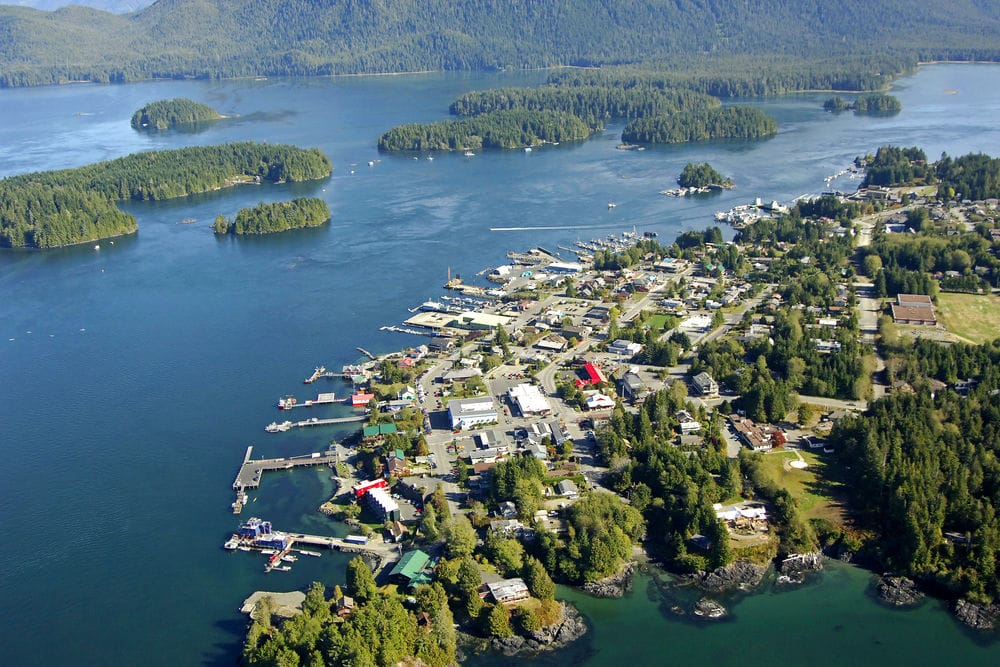
Tofino
Lending guidelines for Tofino, British Columbia
Last reviewed by Bridgefort Capital on
Show on MapLending Snapshot
Tofino is a remote, world-famous tourist town at the end of the road, meaning the real estate market relies heavily on outside vacation buyers. Because the local economy is entirely exposed to tourism, we keep things conservative here. Bridgefort Capital caps exposure at a maximum LTV of 55.0% to protect against a sudden travel slump.
Underwriting the Peninsula: Tofino Lending Strategy
Brokers looking at Tofino need to look past the postcard images of old-growth rainforests and surf culture. From a lending perspective, this is an isolated micro-market with specific geographic and economic constraints. Located at the terminus of Highway 4 on Vancouver Island, the town is physically hemmed in by the Pacific Ocean and protected parklands, leaving zero room for outward expansion.
With a population of 2,516, Tofino has grown by 27.9% since 2016, but its land area remains locked at just 10.56 square kilometers. This lack of land creates a permanent supply bottleneck. Single-detached houses make up 50.8% of the local housing stock, followed by apartments under five storeys at 13.2%, and movable dwellings at 9.5%. Demand for vacation rentals and secondary homes has decoupled property values from local wages, making housing affordability a chronic issue.
Demographically, the market is young. The median age is 36, and 75% of the population falls within the prime working-age bracket of 15 to 64. However, the local economy is highly concentrated. Accommodation and food services employ 27.9% of the workforce, followed by retail trade at 12.9% and construction at 9.5%. This heavy reliance on tourism leads to a baseline unemployment rate of 12.0%. While summer business is lucrative, off-season volatility makes traditional debt-service underwriting difficult.
Daily life here is self-contained but remote. Locally, commuting is short, with 75.9% of residents traveling under 15 minutes to work, averaging a 14.0-minute commute. However, accessing major retail, construction materials, or specialized healthcare requires a multi-hour drive over mountain passes to Port Alberni or Nanaimo. Winter washouts and power outages can cut off the peninsula entirely.
Bridgefort Capital lends exclusively outside the Lower Mainland, meaning we are built to handle isolated, resort-driven micro-markets. Traditional institutional lenders often walk away from files involving seasonal tourism income or self-employed structures, like charter operators or local contractors. Because we are an equity-based mortgage investment corporation, we look past standard debt-service ratios to focus on the underlying asset value and the borrower’s overall equity position.
That said, liquidity is the primary risk on the coast. If a loan goes into default, executing a power of sale in a remote community is slow, particularly during the winter market lull. Because of these geographic and economic realities, our maximum loan-to-value ratio in Tofino is 55.0%. We look for files with strong equity positions and clear, realistic exit strategies. If you have a client on the peninsula who has the equity, run the scenario by us.
the Nearest Tim Hortons
the Nearest Costco
Frequently Asked Questions
We cap lending at 55.0% LTV because of the high concentration of risk in a single industry. If tourism takes a hit, local real estate liquidity dries up fast, making it hard for us to recover capital in a worst-case scenario.
The economy is built entirely on tourism, with high unemployment (12%) and local incomes that can't support high-end real estate. To get a deal done, you need to show your buyer has strong outside income or serious equity, rather than relying on the local economy.
Any deal requiring high leverage or relying on weak local borrowers will get rejected immediately. If the buyer doesn't have a massive equity cushion to offset the risk of a tourism downturn, we won't do it.
Our Mortgage Products Available in Tofino
| Mortgage Product Name | Max LTV | Key Notes for Tofino |
|---|---|---|
| Variable Income | 55.0% | Standard product terms |
| Bare Land and Unique Properties | 55.0% | Standard product terms |
| Bridge Financing | 55.0% | Standard product terms |
| Equity Lending / Refinance | 55.0% | Standard product terms |
| Purchases | 55.0% | Standard product terms |
Detailed Mortgage Product Information
Variable Income
Maximum Loan-to-Value (LTV) for Variable Income in Tofino:
55.0 %
“Their income is all over the map, but there’s definitely income…”
Here’s a funny thing about lending based on Line 15000 of your Notice of Assessment: It’s a neat little box to underwrite against. Works great if you’re a salaried employee. Not so great if you’re running a fishing charter in Campbell River where thres fishing season, and the rest of the year.
We get it. Income isn’t always ti...
Bare Land and Unique Properties
Maximum Loan-to-Value (LTV) for Bare Land and Unique Properties in Tofino:
55.0 %
“The appraisal came back as ‘property type: other’…”
Here’s a truth about real estate that nobody wants to admit: not everything fits in a box. Banks have boxes. Nice, tidy boxes labeled “single family home” and “condo” and “townhouse.” Their computer systems literally don’t have a dropdown menu option for “converted church with commercial kitchen” or “geodesic dome on 40 acres.”
We’ve funded...
Bridge Financing
Maximum Loan-to-Value (LTV) for Bridge Financing in Tofino:
55.0 %
“Subjects came off their current home last week but their new place closes Friday…”
Here’s a funny thing about bridge financing: everyone thinks it’s complicated. It’s not. Someone needs to close on their new house before their old house sells. Or their sale fell through after they removed subjects on their dream home. Or they found the perfect downsizer condo but haven’t listed the family hom...
Equity Lending / Refinance
Maximum Loan-to-Value (LTV) for Equity Lending / Refinance in Tofino:
55.0 %
“They have tons of equity but don’t qualify under B20…”
Here’s the thing about equity lending: it exists because banks literally can’t do it. B20 guidelines require income verification. Full stop. No wiggle room. No common sense exceptions.
We’re provincially regulated. The funds we lend on come from individual investors, not the Bank of Canada. So when your client has 50% equity but their in...
Purchases
Maximum Loan-to-Value (LTV) for Purchases in Tofino:
55.0 %
Moving is supposed to be exciting. New town, new job, new chapter. So why do banks act like you’re asking for their firstborn when you need a mortgage?
“You haven’t been at your new job for thre months”
“Your self-employment income doesn’t count in a new market.”
“We need to see established a year if you are part time contract - even if you’re working 40 hours under your new role”
Meanwhile...