For Brokers
Estimate your max LTV in seconds
Pick the town, product, credit score, and how close the property is — we'll show the maximum loan-to-value we can consider. No sign-up, no obligation.
Trail
Lending guidelines for Trail, British Columbia
Last reviewed by Bridgefort Capital on
Show on MapLending Snapshot
Trail is a stable, blue-collar industrial town where folks put down deep roots, but the heavy reliance on the Teck smelter keeps things sensitive. Because of this single-industry risk, we cap our max LTV at 60.0%. It’s a great market for sensible, equity-based deals, we just need to underwrite with our eyes open to the local economic realities.
Trail, BC: A Blue-Collar Anchor in the Kootenays
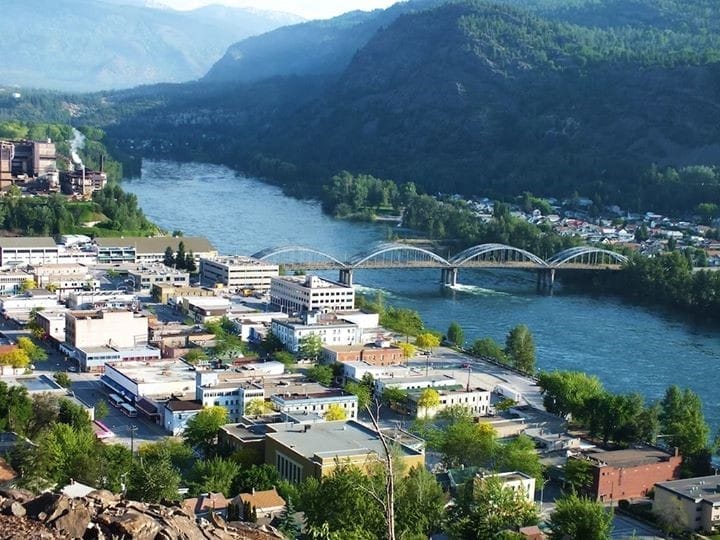
If your clients are looking for a boutique tourist town with artisan cafes, they should head up the hill to Rossland. Trail is a straightforward, industrial city, and the real estate market reflects that blue-collar reality. The local skyline and the economy are both anchored by the massive Teck lead-zinc smelter down in the valley. This is a multi-generational town where people work at the plant, play bocce at the Italian clubs, and support the Smoke Eaters at the Cominco Arena. For mortgage brokers, Trail offers a stable, predictable lending environment without the wild, speculative swings seen in BC’s resort markets.
Single-detached homes dominate the landscape, making up 70.4% of the housing stock. Because the city is pinned between the Columbia River and steep mountain valley walls, many of these are older character homes built on hillside terraces. You will encounter steep driveways and older foundations here, not sprawling new subdivisions. It is a mature, stable market with a median age of 49. Houses sell based on local employment, not out-of-town lifestyle buyers. This keeps prices significantly lower than in Nelson or Kelowna, making Trail an entry point for first-time buyers and tradespeople looking to build equity.
Economically, the city is remarkably resilient, earning an 8 out of 10 on our internal economic rating. While the Teck smelter is the high-paying industrial anchor, Trail is also the primary healthcare and service hub for the West Kootenays. Health care and social assistance make up the largest employment sector at 16.0%, driven by the Kootenay Boundary Regional Hospital. Retail trade follows closely at 15.1%, and manufacturing accounts for 11.9%. This diversified employment base keeps housing demand steady. It also makes for short commutes, with 68.0% of residents spending under 15 minutes getting to work, averaging a brief 14.9-minute trip.
At Bridgefort Capital, we do not need the rapid-fire appreciation of the Lower Mainland to write a mortgage. We look for stability, and Trail has plenty of it. We provide equity loans, debt consolidation, and second mortgages for Trail borrowers who do not fit the rigid check-boxes of A lenders or local credit unions. Whether you have a client working at the smelter who needs quick bridge financing, or a buyer looking to renovate an older hillside home, we want to look at the deal.
With a population of 7,920 and a 2.7% growth rate since 2016, Trail remains a stable sub-market. Because the housing stock is older and average days-on-market can be longer than in major urban centers, we manage our risk by maintaining a maximum LTV of 60.0% in this community. This keeps our investors protected while giving you a reliable, common-sense alternative lending option in the West Kootenays.
the Nearest Costco
Frequently Asked Questions
We cap lending at 60.0% LTV because of Trail's single-industry concentration around the smelter. While the community is incredibly stable, a downturn in the resource sector can slow down property sales, so we keep a conservative buffer.
It's a gritty, blue-collar market with a median age near 50, meaning people buy homes to live in them long-term, not to speculate. The Teck smelter is the big anchor, but healthcare and retail also employ a big chunk of the town, giving us a highly reliable borrower pool.
Any deal looking to push past 60.0% LTV or involving high-turnover rental properties and speculative vacation homes will get a quick 'no.' We're looking for standard, owner-occupied primary residences with plenty of solid equity.
Our Mortgage Products Available in Trail
| Mortgage Product Name | Max LTV | Key Notes for Trail |
|---|---|---|
| Credit Repair and Debt Consolidation | 60.0% | Standard product terms |
| Variable Income | 60.0% | Standard product terms |
| Bare Land and Unique Properties | 60.0% | Standard product terms |
| Bridge Financing | 60.0% | Standard product terms |
| Equity Lending / Refinance | 60.0% | Standard product terms |
| Purchases | 60.0% | Standard product terms |
Detailed Mortgage Product Information
Credit Repair and Debt Consolidation
Maximum Loan-to-Value (LTV) for Credit Repair and Debt Consolidation in Trail:
60.0 %
“Their credit report reads like a horror novel, but the house was just renovated and is worth a lot…”
Here’s what happens when life takes a wrong turn. A bad business venture. Workplace Injury. That divorce that dragged on for two years. Suddenly your credit score looks like a batting average and the banks won’t even return your calls.
But here’s the thing – none of that changes what your ho...
Variable Income
Maximum Loan-to-Value (LTV) for Variable Income in Trail:
60.0 %
“Their income is all over the map, but there’s definitely income…”
Here’s a funny thing about lending based on Line 15000 of your Notice of Assessment: It’s a neat little box to underwrite against. Works great if you’re a salaried employee. Not so great if you’re running a fishing charter in Campbell River where thres fishing season, and the rest of the year.
We get it. Income isn’t always ti...
Bare Land and Unique Properties
Maximum Loan-to-Value (LTV) for Bare Land and Unique Properties in Trail:
60.0 %
“The appraisal came back as ‘property type: other’…”
Here’s a truth about real estate that nobody wants to admit: not everything fits in a box. Banks have boxes. Nice, tidy boxes labeled “single family home” and “condo” and “townhouse.” Their computer systems literally don’t have a dropdown menu option for “converted church with commercial kitchen” or “geodesic dome on 40 acres.”
We’ve funded...
Bridge Financing
Maximum Loan-to-Value (LTV) for Bridge Financing in Trail:
60.0 %
“Subjects came off their current home last week but their new place closes Friday…”
Here’s a funny thing about bridge financing: everyone thinks it’s complicated. It’s not. Someone needs to close on their new house before their old house sells. Or their sale fell through after they removed subjects on their dream home. Or they found the perfect downsizer condo but haven’t listed the family hom...
Equity Lending / Refinance
Maximum Loan-to-Value (LTV) for Equity Lending / Refinance in Trail:
60.0 %
“They have tons of equity but don’t qualify under B20…”
Here’s the thing about equity lending: it exists because banks literally can’t do it. B20 guidelines require income verification. Full stop. No wiggle room. No common sense exceptions.
We’re provincially regulated. The funds we lend on come from individual investors, not the Bank of Canada. So when your client has 50% equity but their in...
Purchases
Maximum Loan-to-Value (LTV) for Purchases in Trail:
60.0 %
Moving is supposed to be exciting. New town, new job, new chapter. So why do banks act like you’re asking for their firstborn when you need a mortgage?
“You haven’t been at your new job for thre months”
“Your self-employment income doesn’t count in a new market.”
“We need to see established a year if you are part time contract - even if you’re working 40 hours under your new role”
Meanwhile...