For Brokers
Estimate your max LTV in seconds
Pick the town, product, credit score, and how close the property is — we'll show the maximum loan-to-value we can consider. No sign-up, no obligation.
Mackenzie
Lending guidelines for Mackenzie, British Columbia
Last reviewed by Tekamar Mortgage Fund on
Show on MapLending Snapshot
Mackenzie is an isolated, single-industry mill town where we cap our LTV at 50.0%. The economy is heavily exposed to forestry downturns, with high unemployment and a shrinking population. It's a decent market for local homeowners with solid equity who need a bridge, but we don't touch speculative deals here.
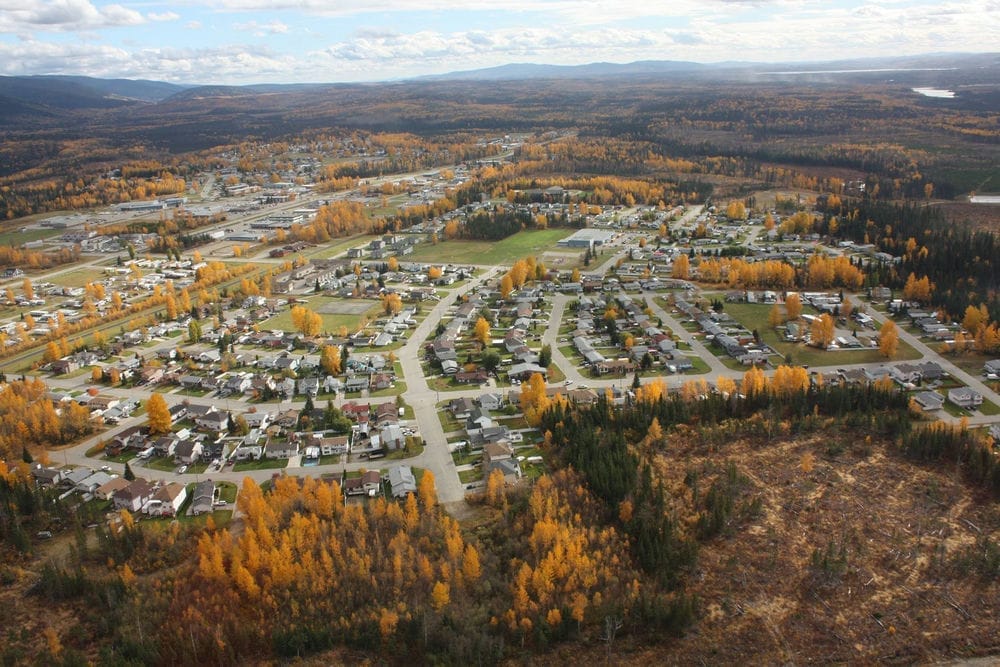
Underwriting a deal in Mackenzie requires a cold, hard look at the reality on the ground. This isn’t a tourism-driven weekend getaway or a scenic Okanagan resort town. It is a classic, no-nonsense northern BC “instant town,” carved out of the wilderness in the 1960s to service the Peace River hydro projects and the regional timber limits. Located forty kilometers off Highway 97 and roughly two hours north of Prince George, nobody ends up in Mackenzie by accident. People move here for one reason: work.
The local economy lives and dies by the forestry and manufacturing sectors, which make up nearly a third of all local employment. Major players like Conifex and Paper Excellence drive the market, making the entire town highly sensitive to global commodity cycles. This economic concentration is reflected in the demographic data. The population has stabilized at 3,281 residents, representing zero growth over the last several years. While those with steady industrial jobs earn decent wages, the broader economic volatility shows in the numbers, with the local unemployment rate sitting at a high 12.3%. It is a blue-collar, working-age demographic where 65% of the population falls between 15 and 64, and they are highly reliant on these primary industries.
For mortgage brokers, this dynamic translates to highly affordable housing prices, but with a serious side order of market volatility. The housing stock is exactly what you would expect from a mid-century instant town. Single-family detached homes dominate the market at 66.7%, while movable dwellings and mobile homes make up a substantial 13.5%. The buyer pool is almost entirely local, consisting of plant workers, contractors, and retirees. Despite the proximity to Williston Lake, a true recreational or secondary cabin market does not exist here. If the mills face a downturn, local inventory sits, and finding a qualified buyer can become an uphill battle.
At Tekamar, we do not shy away from northern resource towns. We are the mortgage investment corporation that steps in when major banks and credit unions pull their capital back to metropolitan areas. We understand how to structure bridge financing and alternative mortgages for clients who have solid equity but do not fit the rigid boxes of prime lenders.
However, we have to price and structure our deals for the reality of the exit. If a major employer idles its operations, liquidity in Mackenzie dries up overnight, and selling a property can drag on for months or even years. To protect our portfolio from getting locked into extended foreclosure proceedings, we cap our maximum leverage here. Our maximum loan-to-value for Mackenzie is strictly capped at 50%.
This conservative limit allows us to remain active in the market when other alternative lenders refuse to quote. If you have a client in Mackenzie with a strong equity position and a clean exit strategy, we want to see the file. We just need to keep the leverage conservative enough to balance the market’s liquidity risks.
the Nearest Tim Hortons
the Nearest Costco
Frequently Asked Questions
Our max LTV is capped at 50.0% because of the high risk associated with a remote, single-industry town. The combination of geographic isolation and a shrinking population means we need a conservative equity cushion.
Over a third of the workforce relies on forestry, meaning a single mill closure can devastate the local real estate market. Because of this economic fragility, we look closely at the borrower's personal stability and exit strategy rather than relying on a quick property sale.
Speculative financing, weak borrower equity, or a lack of a realistic exit plan will kill a deal instantly. With Mackenzie being a two-hour drive from Prince George and having a very shallow buyer pool, we can't take on files that don't have solid local roots.
Our Mortgage Products Available in Mackenzie
| Mortgage Product Name | Max LTV | Key Notes for Mackenzie |
|---|---|---|
| Bare Land and Unique Properties | 50.0% | Standard product terms |
| Bridge Financing | 50.0% | Standard product terms |
| Equity Lending / Refinance | 50.0% | Standard product terms |
| Purchases | 50.0% | Standard product terms |
Detailed Mortgage Product Information
Bare Land and Unique Properties
Maximum Loan-to-Value (LTV) for Bare Land and Unique Properties in Mackenzie:
50.0 %
“The appraisal came back as ‘property type: other’…”
Here’s a truth about real estate that nobody wants to admit: not everything fits in a box. Banks have boxes. Nice, tidy boxes labeled “single family home” and “condo” and “townhouse.” Their computer systems literally don’t have a dropdown menu option for “converted church with commercial kitchen” or “geodesic dome on 40 acres.”
We’ve funded...
Bridge Financing
Maximum Loan-to-Value (LTV) for Bridge Financing in Mackenzie:
50.0 %
“Subjects came off their current home last week but their new place closes Friday…”
Here’s a funny thing about bridge financing: everyone thinks it’s complicated. It’s not. Someone needs to close on their new house before their old house sells. Or their sale fell through after they removed subjects on their dream home. Or they found the perfect downsizer condo but haven’t listed the family hom...
Equity Lending / Refinance
Maximum Loan-to-Value (LTV) for Equity Lending / Refinance in Mackenzie:
50.0 %
“They have tons of equity but don’t qualify under B20…”
Here’s the thing about equity lending: it exists because banks literally can’t do it. B20 guidelines require income verification. Full stop. No wiggle room. No common sense exceptions.
We’re provincially regulated. The funds we lend on come from individual investors, not the Bank of Canada. So when your client has 50% equity but their in...
Purchases
Maximum Loan-to-Value (LTV) for Purchases in Mackenzie:
50.0 %
Moving is supposed to be exciting. New town, new job, new chapter. So why do banks act like you’re asking for their firstborn when you need a mortgage?
“You haven’t been at your new job for thre months”
“Your self-employment income doesn’t count in a new market.”
“We need to see established a year if you are part time contract - even if you’re working 40 hours under your new role”
Meanwhile...