For Brokers
Estimate your max LTV in seconds
Pick the town, product, credit score, and how close the property is — we'll show the maximum loan-to-value we can consider. No sign-up, no obligation.
Cache Creek
Lending guidelines for Cache Creek, British Columbia
Last reviewed by Tekamar Mortgage Fund on
Show on MapLending Snapshot
Here's the deal on Cache Creek: it's a quiet, rural crossroads town where we cap lending at 55.0% LTV. The local economy is fragile with 13% unemployment, meaning the buyer pool is incredibly thin. If you bring us a deal here, you'll need an exceptionally strong borrower and a rock-solid exit strategy.
Cache Creek: Market Reality
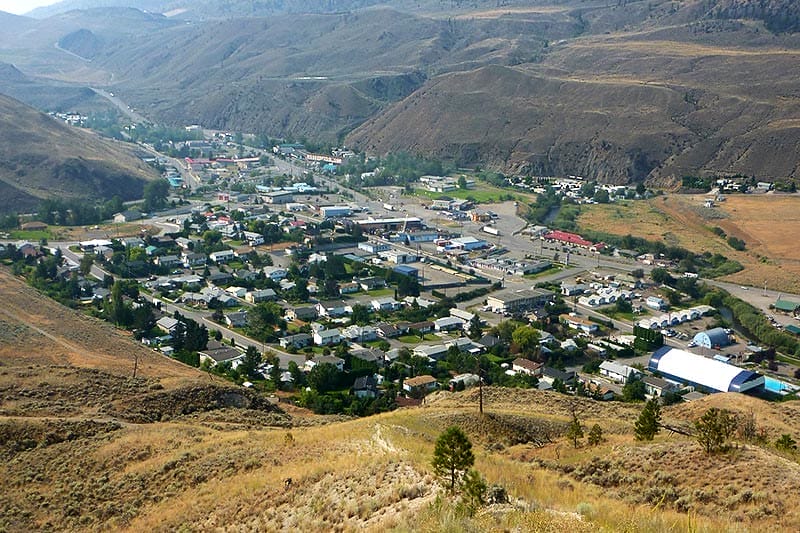
Anyone driving the BC Interior knows Cache Creek. It is the junction where the Trans-Canada meets Highway 97. Visually, it is an anomaly for British Columbia. Instead of green pines and coastal rain, you get a dry, dusty valley covered in sagebrush. It looks and feels more like Nevada than the Pacific Northwest.
With a population of just 969, it is a classic highway pit stop. It is not a resort destination, and there is no real estate boom here. It is a quiet, inexpensive place to live, supported by local ranching, retail, and the constant flow of semi-trucks and travelers heading north into the Cariboo.
The Local Economy and Housing
To fund a deal here, you have to look at the actual numbers. Cache Creek runs on highway traffic. We are talking about motels, gas stations, diners, and transport services. The economic base is small and highly specific, with accommodation, food services, and transportation making up the bulk of local employment. The median household income is low, and the local unemployment rate sits at 13.0%. The demographic skew is also older; the median age is 57, and seniors make up 31% of the population. People move here to stretch their pensions, accepting the 80-kilometer drive to Kamloops when they need major healthcare or big-box shopping.
The housing stock reflects this utility. Out of 522 private dwellings, 53.2% are older single-detached homes, and 27.7% are mobile or manufactured homes. You will not find developers building speculative subdivisions or modern townhomes here. Real estate moves slowly. Buyers are almost exclusively locals or seniors looking for an affordable alternative to Kamloops prices.
How We Lend in Cache Creek
We write mortgages in Cache Creek, but we do it with realistic expectations. If a borrower defaults in a market this small, power of sale proceedings take time. There is no active pool of buyers waiting to jump on listings. Since we lend capital from private investors, preserving that principal is our priority. We have to price in the slow resale velocity, the older housing types, and the lack of diverse local employers.
Because of these local market constraints, our maximum loan-to-value in Cache Creek is capped at 55.0%.
We are comfortable with equity takeouts, debt consolidation, and bridge loans here, provided there is a solid equity cushion to insulate our files from extended marketing times. We built our mortgage investment corporation by understanding the spaces between BC’s major cities, and Cache Creek is exactly that kind of market. If you have a client with sufficient equity who needs an alternative solution, send us the scenario. We know the Interior, we understand the local risks, and we will give you a quick, direct decision.
the Nearest Costco
Nearest Hospital
Frequently Asked Questions
We cap lending at 55.0% LTV to protect against severe liquidation risk. Because the market is entirely local with an aging population and no outside buyers, selling a property quickly during a default is incredibly difficult.
The economy is highly undiversified, relying almost entirely on transport and accommodation with a high 13% unemployment rate. To get a deal done, we need to see strong borrowers who aren't highly vulnerable to local economic shifts.
A weak borrower, an unclear exit strategy, or trying to finance a movable dwelling, which makes up nearly 28% of the local housing stock. We need plain-vanilla real estate and highly qualified clients to look at this market.
Our Mortgage Products Available in Cache Creek
| Mortgage Product Name | Max LTV | Key Notes for Cache Creek |
|---|---|---|
| Variable Income | 55.0% | Standard product terms |
| Bare Land and Unique Properties | 55.0% | Standard product terms |
| Bridge Financing | 55.0% | Standard product terms |
| Equity Lending / Refinance | 55.0% | Standard product terms |
| Purchases | 55.0% | Standard product terms |
Detailed Mortgage Product Information
Variable Income
Maximum Loan-to-Value (LTV) for Variable Income in Cache Creek:
55.0 %
“Their income is all over the map, but there’s definitely income…”
Here’s a funny thing about lending based on Line 15000 of your Notice of Assessment: It’s a neat little box to underwrite against. Works great if you’re a salaried employee. Not so great if you’re running a fishing charter in Campbell River where thres fishing season, and the rest of the year.
We get it. Income isn’t always ti...
Bare Land and Unique Properties
Maximum Loan-to-Value (LTV) for Bare Land and Unique Properties in Cache Creek:
55.0 %
“The appraisal came back as ‘property type: other’…”
Here’s a truth about real estate that nobody wants to admit: not everything fits in a box. Banks have boxes. Nice, tidy boxes labeled “single family home” and “condo” and “townhouse.” Their computer systems literally don’t have a dropdown menu option for “converted church with commercial kitchen” or “geodesic dome on 40 acres.”
We’ve funded...
Bridge Financing
Maximum Loan-to-Value (LTV) for Bridge Financing in Cache Creek:
55.0 %
“Subjects came off their current home last week but their new place closes Friday…”
Here’s a funny thing about bridge financing: everyone thinks it’s complicated. It’s not. Someone needs to close on their new house before their old house sells. Or their sale fell through after they removed subjects on their dream home. Or they found the perfect downsizer condo but haven’t listed the family hom...
Equity Lending / Refinance
Maximum Loan-to-Value (LTV) for Equity Lending / Refinance in Cache Creek:
55.0 %
“They have tons of equity but don’t qualify under B20…”
Here’s the thing about equity lending: it exists because banks literally can’t do it. B20 guidelines require income verification. Full stop. No wiggle room. No common sense exceptions.
We’re provincially regulated. The funds we lend on come from individual investors, not the Bank of Canada. So when your client has 50% equity but their in...
Purchases
Maximum Loan-to-Value (LTV) for Purchases in Cache Creek:
55.0 %
Moving is supposed to be exciting. New town, new job, new chapter. So why do banks act like you’re asking for their firstborn when you need a mortgage?
“You haven’t been at your new job for thre months”
“Your self-employment income doesn’t count in a new market.”
“We need to see established a year if you are part time contract - even if you’re working 40 hours under your new role”
Meanwhile...