For Brokers
Estimate your max LTV in seconds
Pick the town, product, credit score, and how close the property is — we'll show the maximum loan-to-value we can consider. No sign-up, no obligation.
Chase
Lending guidelines for Chase, British Columbia
Last reviewed by Bridgefort Capital on
Show on MapLending Snapshot
Chase is a stable Shuswap lifestyle market, but the local economy is quiet, so Bridgefort Capital caps LTV at 60.0%. While retirees and tourism keep property values steady, low household incomes and high unemployment mean we need a conservative buffer. If your client has the equity, we can make deals happen here.
Underwriting Chase: Shuswap’s Gateway Market
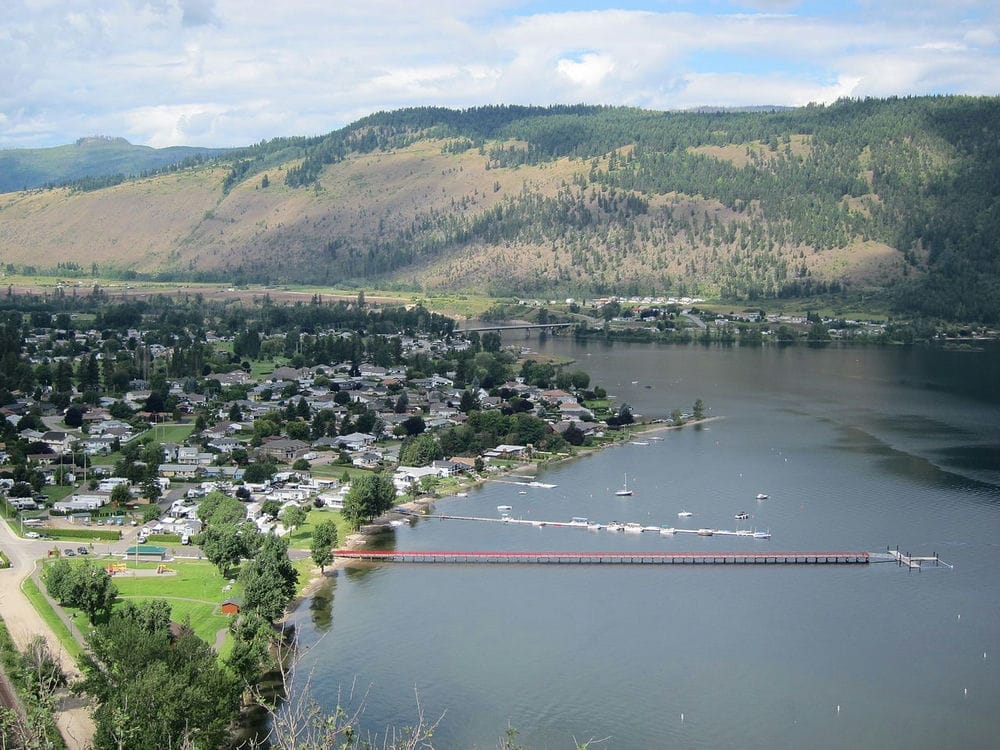
Chase sits at the outlet of Little Shuswap Lake where it feeds the South Thompson River, serving as a critical alternative market to Kamloops. Geographically constrained to just 3.75 square kilometers, the town is pinched by water and terrain. This tight footprint keeps land supply limited, which helps insulate local property values. While historically tied to forestry, modern Chase functions primarily as a retirement destination and a bedroom community for people commuting down the Trans-Canada Highway.
From an underwriting perspective, the demographics dictate the local economy. The median age of this 2,399-person community is 59, and seniors make up 39% of the population. Consequently, the local employment rate sits at 39.0%, with an unemployment rate of 9.4%. These figures do not indicate a failing economy; rather, they reflect a stable, asset-rich retired population. For working residents, the job base relies on retail trade, construction, and healthcare. Exactly 38.8% of working locals have a short commute under 15 minutes, while the rest travel into Kamloops, bringing the overall average commute time to 29.2 minutes.
The housing stock is highly predictable. Single-detached homes dominate the landscape at 74.9% of all private dwellings. Movable dwellings, including modular and manufactured homes, represent another 8.1%, with low-rise apartments and row houses making up the remainder. Because entry-level prices are significantly lower than in Kamloops or Salmon Arm, demand remains steady for both retiring downsizers and working families looking for affordable detached housing.
Municipal infrastructure supports this steady demand. Recent water and sewer upgrades have paved the way for infill projects and residential expansion west of Chase Creek, preventing the market from stagnating. While summer tourism brings seasonal activity to the Shuswap, the real estate market in Chase is driven by year-round residents rather than recreational properties.
With a Community Desirability Score of 7/10 and an Economic Score of 7/10, Chase represents a reliable, stable secondary market. The community benefits from steady demand, geographic boundaries that prevent oversupply, and close proximity to Kamloops. However, because it is smaller and less liquid than a major urban center, Bridgefort Capital caps loans in this community at a maximum LTV of 60.0%. This loan-to-value threshold mitigates liquidity risk while providing brokers with options for equity take-outs, bridge loans, or debt consolidation for clients looking to leverage their holdings in the Shuswap region.
the Nearest Tim Hortons
the Nearest Costco
Nearest Hospital
Frequently Asked Questions
Our max LTV is capped at 60.0% to offset the town's economic vulnerabilities. While real estate demand is stable, Chase has a low median household income of $60,400 and a high 9.4% unemployment rate, requiring a conservative equity buffer.
The economy relies on tourism, agriculture, and retirees, meaning many locals don't fit prime-lender income boxes. We can easily bypass rigid income verification, but we need to see a realistic exit strategy and solid equity to approve the deal.
A deal will fall apart if the LTV pushes past 60.0% or if there is no clear, viable exit strategy. Because the local economy isn't dynamic enough to easily absorb financial shocks, we cannot stretch on equity or accept a weak payout plan.
Our Mortgage Products Available in Chase
| Mortgage Product Name | Max LTV | Key Notes for Chase |
|---|---|---|
| Credit Repair and Debt Consolidation | 60.0% | Standard product terms |
| Variable Income | 60.0% | Standard product terms |
| Bare Land and Unique Properties | 60.0% | Standard product terms |
| Bridge Financing | 60.0% | Standard product terms |
| Equity Lending / Refinance | 60.0% | Standard product terms |
| Purchases | 60.0% | Standard product terms |
Detailed Mortgage Product Information
Credit Repair and Debt Consolidation
Maximum Loan-to-Value (LTV) for Credit Repair and Debt Consolidation in Chase:
60.0 %
“Their credit report reads like a horror novel, but the house was just renovated and is worth a lot…”
Here’s what happens when life takes a wrong turn. A bad business venture. Workplace Injury. That divorce that dragged on for two years. Suddenly your credit score looks like a batting average and the banks won’t even return your calls.
But here’s the thing – none of that changes what your ho...
Variable Income
Maximum Loan-to-Value (LTV) for Variable Income in Chase:
60.0 %
“Their income is all over the map, but there’s definitely income…”
Here’s a funny thing about lending based on Line 15000 of your Notice of Assessment: It’s a neat little box to underwrite against. Works great if you’re a salaried employee. Not so great if you’re running a fishing charter in Campbell River where thres fishing season, and the rest of the year.
We get it. Income isn’t always ti...
Bare Land and Unique Properties
Maximum Loan-to-Value (LTV) for Bare Land and Unique Properties in Chase:
60.0 %
“The appraisal came back as ‘property type: other’…”
Here’s a truth about real estate that nobody wants to admit: not everything fits in a box. Banks have boxes. Nice, tidy boxes labeled “single family home” and “condo” and “townhouse.” Their computer systems literally don’t have a dropdown menu option for “converted church with commercial kitchen” or “geodesic dome on 40 acres.”
We’ve funded...
Bridge Financing
Maximum Loan-to-Value (LTV) for Bridge Financing in Chase:
60.0 %
“Subjects came off their current home last week but their new place closes Friday…”
Here’s a funny thing about bridge financing: everyone thinks it’s complicated. It’s not. Someone needs to close on their new house before their old house sells. Or their sale fell through after they removed subjects on their dream home. Or they found the perfect downsizer condo but haven’t listed the family hom...
Equity Lending / Refinance
Maximum Loan-to-Value (LTV) for Equity Lending / Refinance in Chase:
60.0 %
“They have tons of equity but don’t qualify under B20…”
Here’s the thing about equity lending: it exists because banks literally can’t do it. B20 guidelines require income verification. Full stop. No wiggle room. No common sense exceptions.
We’re provincially regulated. The funds we lend on come from individual investors, not the Bank of Canada. So when your client has 50% equity but their in...
Purchases
Maximum Loan-to-Value (LTV) for Purchases in Chase:
60.0 %
Moving is supposed to be exciting. New town, new job, new chapter. So why do banks act like you’re asking for their firstborn when you need a mortgage?
“You haven’t been at your new job for thre months”
“Your self-employment income doesn’t count in a new market.”
“We need to see established a year if you are part time contract - even if you’re working 40 hours under your new role”
Meanwhile...